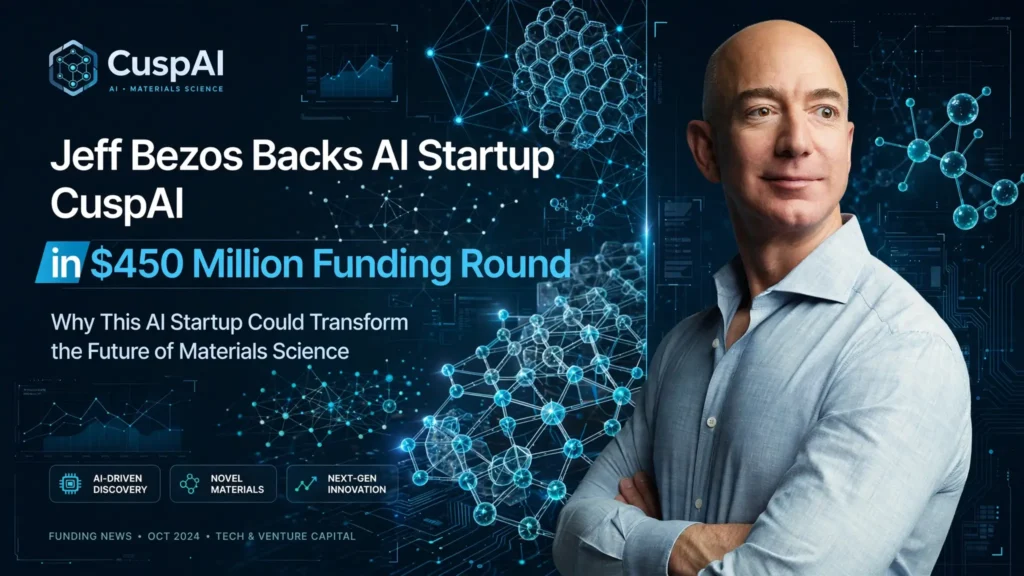
Jeff Bezos Backs AI Startup CuspAI in $450 Million Funding Round – What It Means for the Future of AI
Jeff Bezos backs AI startup CuspAI in a $450 million funding round. Learn how CuspAI plans to revolutionize materials discovery with artificial intelligence.
Jeff Bezos Backs AI Startup CuspAI in $450 Million Funding Round
Artificial intelligence continues to attract record-breaking investments, and one of the latest examples is CuspAI, a UK-based startup developing AI for advanced materials discovery. The company recently secured $450 million in fresh funding, with support from Amazon founder Jeff Bezos, alongside other major investors.
The investment is more than another large funding announcement. It reflects growing confidence that AI can solve complex scientific challenges that traditionally require years of laboratory research. Rather than focusing on chatbots or content generation, CuspAI is using artificial intelligence to accelerate the discovery of new materials for clean energy, electronics, manufacturing, and industrial applications.
For entrepreneurs, investors, and technology enthusiasts, the funding round signals another major milestone in the expanding AI economy.
What Is CuspAI?
CuspAI is an artificial intelligence company focused on AI-powered materials discovery. Instead of creating consumer AI tools, the startup develops machine-learning systems capable of predicting the properties of entirely new materials before they are manufactured.
Traditionally, discovering a new material requires years of experiments, expensive laboratory testing, and countless failed attempts. CuspAI aims to dramatically reduce this timeline by allowing AI to analyze millions of possible material combinations digitally before scientists begin physical testing.
This approach has the potential to save enormous amounts of time and research costs.
Why Jeff Bezos Invested
Jeff Bezos has consistently invested in companies working on long-term technological breakthroughs rather than short-term trends.
His interest in CuspAI appears to align with several major global opportunities:
- Artificial Intelligence
- Climate Technology
- Advanced Manufacturing
- Scientific Computing
- Clean Energy Innovation
As industries seek better batteries, stronger construction materials, improved semiconductors, and carbon-capture technologies, the ability to discover materials faster becomes increasingly valuable.
Rather than investing in another AI chatbot, Bezos is backing infrastructure that could support multiple industries over the next decade.
Why Materials Discovery Matters
Many of today’s biggest technological challenges depend on discovering better materials.
Examples include:
- Longer-lasting EV batteries
- Faster computer chips
- Efficient solar panels
- Hydrogen storage systems
- Carbon capture technologies
- Aerospace components
- Medical devices
Developing these materials through conventional research can take several years.
AI dramatically shortens this process by identifying promising candidates before laboratory testing begins.
Researchers can focus only on the most promising options instead of experimenting with thousands of possibilities.
The Growing Market for Scientific AI
Artificial intelligence is rapidly moving beyond text generation.
Today, AI is being applied to:
- Drug discovery
- Protein engineering
- Climate modeling
- Robotics
- Manufacturing
- Materials science
- Industrial automation
Many venture capital firms now believe that AI-powered scientific research could become one of the largest technology markets of the next decade.
As computing power increases, AI systems are becoming better at identifying complex relationships hidden within massive scientific datasets.
How CuspAI’s Technology Works
Although the company has not publicly disclosed every technical detail, its platform generally combines:
- Large scientific datasets
- Machine learning models
- Physics simulations
- Chemical property prediction
- High-performance computing
Instead of replacing scientists, the AI assists researchers by narrowing millions of possibilities into a much smaller group of high-potential materials.
Scientists can then verify these predictions through laboratory experiments.
This collaboration between AI and human expertise may significantly improve research efficiency.
Why Investors Are Paying Attention
Several factors make CuspAI attractive to investors.
Massive Commercial Potential
Every industry depends on materials.
If CuspAI discovers breakthrough materials, the commercial opportunities could span automotive, aerospace, electronics, healthcare, energy, and construction.
Long-Term Competitive Advantage
Unlike consumer AI products that face intense competition, scientific AI requires specialized expertise, proprietary data, and strong research capabilities.
This creates higher barriers to entry.
Global Demand
Governments worldwide are investing billions into:
- Green energy
- Semiconductor manufacturing
- Critical minerals
- Climate technology
- Industrial innovation
Companies capable of accelerating scientific discovery could benefit from these long-term trends.
Founder Vision
The founders of CuspAI believe that artificial intelligence should become an essential research partner rather than simply an automation tool.
Their vision is to enable scientists to solve problems that previously required decades of experimentation.
Instead of replacing laboratories, AI enhances their capabilities by dramatically improving efficiency.
This philosophy has attracted both investors and researchers seeking practical applications for artificial intelligence.
Pros and Cons of AI-Powered Materials Discovery
Pros
Faster Innovation
AI significantly reduces the time needed to identify promising materials.
Lower Research Costs
Companies can avoid thousands of expensive laboratory experiments.
Better Sustainability
Improved materials may lead to cleaner energy solutions and lower carbon emissions.
Competitive Advantage
Early discoveries can create valuable patents and licensing opportunities.
Cross-Industry Impact
Breakthrough materials can benefit multiple industries simultaneously.
Cons
High Development Costs
Building advanced AI research platforms requires enormous investment.
Scientific Validation Required
AI predictions still need laboratory confirmation.
Long Commercial Timeline
Scientific discoveries often take years before reaching commercial markets.
Regulatory Challenges
Certain materials may require extensive testing before approval.
Market Uncertainty
Not every AI prediction leads to commercially successful products.
What This Means for the AI Industry
The funding demonstrates that investors are looking beyond generative AI.
The next phase of AI growth is expected to focus on solving real-world industrial and scientific challenges.
Future investment may increasingly flow toward startups developing AI for:
- Healthcare
- Climate technology
- Manufacturing
- Robotics
- Energy
- Scientific research
This shift could diversify the AI ecosystem and reduce reliance on consumer-focused applications.
What It Means for Entrepreneurs
Founders can learn several valuable lessons from CuspAI’s success.
- Focus on solving difficult, high-value problems.
- Build technology with long-term impact.
- Combine deep scientific expertise with AI.
- Address industries with global demand.
- Develop defensible intellectual property.
These principles often attract patient investors willing to support ambitious innovation.
Future Outlook
The coming years will determine whether AI-powered materials discovery becomes a mainstream research method.
If successful, companies like CuspAI could accelerate breakthroughs in renewable energy, transportation, computing, and healthcare.
As governments and private investors continue funding scientific AI, competition in this emerging field is likely to intensify.
Regardless of which company ultimately leads the market, one trend is becoming increasingly clear: artificial intelligence is evolving from a productivity tool into a catalyst for scientific discovery.
Frequently Asked Questions
What is CuspAI?
CuspAI is a UK-based artificial intelligence startup developing AI systems that help discover new advanced materials for industrial and scientific applications.
How much funding did CuspAI raise?
The company announced a funding round totaling $450 million, supported by prominent investors including Jeff Bezos.
Why is Jeff Bezos investing?
The investment reflects growing confidence in AI’s ability to transform scientific research, clean energy, manufacturing, and advanced technology.
What industries could benefit?
Potential applications include renewable energy, electric vehicles, aerospace, healthcare, semiconductor manufacturing, construction, and advanced industrial materials.
Is AI replacing scientists?
No. AI acts as a powerful research assistant by narrowing potential discoveries, while scientists continue validating and developing new materials.
Conclusion
Jeff Bezos’ backing of CuspAI represents more than another headline-making investment. It highlights a broader shift in artificial intelligence—from consumer-facing tools to technologies capable of accelerating scientific and industrial breakthroughs.
By combining AI with materials science, CuspAI aims to shorten research timelines, reduce development costs, and unlock innovations that could reshape industries ranging from clean energy to advanced manufacturing.
While the journey from laboratory discovery to commercial success can take years, the scale of this funding underscores the confidence many investors have in AI’s role as a driver of the next wave of technological progress. For founders, investors, and policymakers alike, CuspAI is a company worth watching.